The kick-off for the Paris 2024 Summer Olympic Games is right around the corner. As fans gear up to watch the world’s best athletes strive for gold, authorities and event organizers are ready to secure one of the biggest public events on earth. But what onlookers might not realize is that level of preparedness doesn’t happen overnight.
Whether it’s Paris, Tokyo, Milan, Vancouver, or the upcoming Olympics in Los Angeles and Brisbane, securing the Olympics takes over a decade of detailed planning and strategizing. It also requires enormous collaboration between law enforcement, public safety, mass transit, airport and parking authorities, as well as city venues, local businesses, and countless other organizations.
So how do major cities secure the Olympics? Learn what considerations help ensure the highest levels of success.
The challenges of managing safety and security at the Olympic Games
Securing a large city is challenging enough. Add 15 million visitors, multiple dispersed venues, and the highest profile global event into the mix, and ‘challenging’ becomes an understatement.
The very nature of the Olympics heightens event security risks such as terrorist attacks, criminal activity, and protests. And with the world watching, the pressure is on. City authorities know that they must always remain one step ahead to keep these threats at bay.

In more recent years, host cities have had to invest a lot in defending against cyberattacks on critical infrastructure or assets linked to the Olympics. One unsecured device or network vulnerability can create a cascade of disruptions across events and halt everyday life in the city.
The ability to identify and respond to these risks is critical to securing the Games. And though keeping residents, visitors, and athletes safe is top of mind, so is ensuring everyone has an enjoyable experience. That alone is an entirely different type of challenge.
Having an influx of people coming into and moving about the city can strain critical infrastructure and resources like roadways, airports, mass transit services, and hospitals. There’s a higher prevalence of fights breaking out, people getting sick or injured, trains and buses reaching full capacity, roads getting jammed up with traffic, and parking lots overflowing. Since these events can have a big impact on people’s experience, it’s all factored into a city’s plan to secure the Olympics.
The biggest challenge of them all? Finding the right balance between securing the Olympic events and the entire city, all while remaining unintrusive so people can have a great experience.
It begins with a unified approach
Many people might believe that the bulk of responsibility for securing the games falls on the shoulders of law enforcement. But securing a city, or an event of this scale, doesn’t happen in isolation.

Securing the Olympics requires large-scale coordination between thousands of people and teams. Police, public safety, first responders, mass transit teams, venue security, and others need to be aligned. Staff and volunteers at Olympic events must also stay connected. There needs to be a constant flow of communication about what’s happening and a clear understanding of what needs to be done when an incident arises. The ideal outcome is that everyone has access to the same information, and that issues can be resolved before they escalate.
This level of collaboration can only happen with a unified approach. In the early planning phases, cities must find ways to bring public and private agencies together. Too often these different teams work in silos and use systems that run independently. This way of working can slow emergency response and limit collaboration.
For all these reasons, cities that host the Olympics consider building central command centers to manage operations. These can be in the form of RTCCs or SOCs and act as a centralized command post that unifies data streams and operations across city departments. Everything from receiving emergency calls and dispatching information to live video, license plate reads, and sensor data stream onto video walls for all operators, investigators, and commanders to see. In seconds, they can all watch what’s unfolding and can act quickly to mitigate the situation.
The importance of the command and control center
Typically, a command and control center, like a real-time crime center (RTCC) or security operations center (SOC) is built on a foundational, front-end solution. Choosing an open and unified security platform allows city authorities to capitalize on their existing technologies or choose devices and systems that best fit their needs.
A platform that is designed to support an RTCC operations can further empower operators with automation. It does this by analyzing and correlating all incoming information and then pointing officers to the most pressing situations. All relevant videos and data are displayed on an interactive city map. This offers added situational context to make faster, more informed decisions.
Having decision support capabilities is also important. This allows the RTCC platform to guide operators through pre-programmed response procedures for various types of events. No matter what stressful situation arises, they can remain confident and in control.
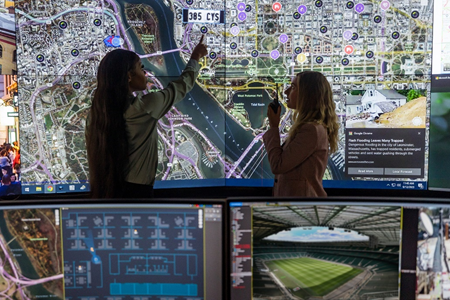
For example, if a gunshot sounds near a venue or an emergency call to authorities comes in, operators will be alerted. They get immediate access to nearby cameras, license plate reads, and any other relevant information. They're then able to share that with nearby patrol officers as they respond. Operators can then monitor the situation in progress, send out any public address notices, provide real-time updates to officers on-scene, coordinate safety measures with nearby venues, and help compile evidence after it’s all over.
Mark Torres of RTCC Commander said, "Using this unified public safety platform, we’ve been able to maximize our RTCC resources to better assist other APD departments, metro partners, and surrounding communities. We’re disseminating real-time information faster, supporting investigations, and tracking crime patterns in our city. All of this helps to enhance public safety for our residents, businesses, and visitors."
How community connections strengthen security
The power of a command center, like a real-time crime center (RTCC) or security operations center (SOC) is that connections aren’t limited to city technologies or departments. With the right physical security platform, host cities can develop public-private partnerships to strengthen security at the Olympics. This involves reaching out to venues, local businesses, and even residents and asking for permission to connect select cameras to the RTCC/SOC.
The benefits of establishing community connections before the Olympics are threefold:
1. Visibility is expanded without additional investments by federating to existing privately owned cameras
2. Collaboration is achieved between law enforcement, public safety, and various other teams
3. Safety efforts are strengthened by cities forging alliances with the community
Another significant benefit to establishing these partnerships is the reinforcement of security at the Olympic events on city streets. For example, cycling races can span 150km through suburban streets and intercity roadways. Having the ability to access camera feeds from devices that are already installed along those routes can be critical for authorities and event organizers to protect athletes and spectators. It provides a broader view of what’s happening, while saving significant taxpayer dollars by using devices that are already in place.
Having technology that can securely bring in camera connections from outside entities is a foundational component. It allows operators to seamlessly request access and manage all public and private devices in one view.
Beyond that, some community connection technologies can even help streamline every aspect of the program. This includes everything from the initial participant and camera registration to the legal terms and conditions. This minimizes the workload in getting these programs up and running.
Commander Kato of Special Olympics World Games said, "t was the first time at a command post, where I felt I never needed to leave. We were able to quickly set up a centralized monitoring facility that connected us to the cameras across each venue. I had enough coverage to get a feel for what was happening at each one of those venues."
Why aligning on security technology matters
At the Olympics, securing major sports venues is a top priority. This is where the main events are hosted and where all fans and athletes gather, so there’s a heightened level of risk.
Many sports venues will typically already have video surveillance, access control, intrusion, intercom, ALPR, and public address systems as well as a host of sensors. A common problem is that security teams may be managing these systems separately.